America Faces a Decisive Test: How Long Will Lebanon Remain an Open Battleground?
By Editor: Piece of Opinion
8/06/2026
(See translation in Arabic section) The question being urgently raised today, following the ongoing Israeli escalation against Lebanon and the subsequent Iranian response against Israel, is no longer a passing question in political analysis. It has become a critical question affecting the future of the entire region: How long will the United States continue to watch from afar? And does Washington possess the political will to take a decisive action that puts an end to Israel's actions against Lebanon, the land of saints and sacred sites?
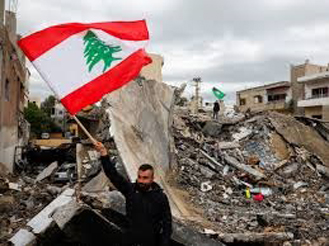
Lebanon, this small country in size but great in its message, history, and spiritual and cultural diversity, cannot remain an open arena for settling scores between Israel and Iran, nor a permanent testing ground for missiles, military responses, and regional messages. Every strike on its soil does not merely target a stone or a military site; it strikes an exhausted society, a devastated economy, and a people still paying the price for wars they did not choose. The recent escalation, with the Israeli strikes on Beirut and southern Lebanon, followed by Iranian missile launches toward Israel, has once again demonstrated the fragility of the regional situation and the danger of turning Lebanon into a permanent front line. Recent media reports indicated that the Israeli strike on Beirut's southern suburbs preceded the Iranian missile launches toward Israel, a development described as one of the most dangerous escalations since the fragile truce last April.
Herein lies the responsibility of the United States. Washington is not a mere observer in this equation; it is Israel's closest ally and wields the most influence over Israeli military and political decisions. Therefore, simply issuing general calls for "restraint" is no longer sufficient. What is required is a clear stance that does not equate the aggressor with the victim and that does not allow Lebanon to become a permanent scapegoat for every crisis in the region.
The United States, which can influence the course of wars and impose conditions on energy issues, sanctions, and nuclear agreements, can also tell Israel: Enough. Enough violating Lebanese airspace. Enough targeting civilian infrastructure. Enough of turning Lebanese villages and cities into bloody battlegrounds for messages directed at Iran, Hezbollah, or others.
Conversely, Iran must also cease using Arab arenas, including Lebanon, as platforms for exerting pressure in its conflict with Israel and the West. Lebanon is not a bargaining chip, a military mailbox, or an alternative front to Tehran. Likewise, the Arab Gulf states, which have long suffered from regional tensions and direct and indirect threats, cannot remain at the mercy of political and military adventures for which civilians, economies, and peoples pay the price.
The time has come for a genuine international decision, led by the United States in cooperation with Europe and the Arab states, to establish a new equation: protecting Lebanon is not a secondary option, but a regional and international necessity. Silence in the face of an attack on Lebanon today means opening the door to a wider war tomorrow, one that could stretch from the Mediterranean to the Gulf, plunging the entire region into an uncontrollable phase.
“Lebanon is not an arena for messages between Israel and Iran, but a homeland with its own people, dignity, and sovereignty. The United States must choose between managing the crisis or preventing a major explosion.”
Lebanon, the land of saints, does not deserve to remain hostage to the missiles of others. Israel, which speaks of its security and its right to defend itself, cannot build its security on destroying the security of its neighbors. Likewise, Iran, which raises the banners of confrontation, has no right to make Lebanon a political and military shield in its larger battles.
What is needed today is not statements of concern, but guarantees. Not diplomatic pronouncements, but real pressure. Not waiting for the next war, but preventing it before it ignites. The region stands on a dangerous precipice, and any miscalculation could plunge everyone into a confrontation in which there are no winners.
Therefore, the question remains directed, above all, to Washington: Will the United States act to stop the slide?
Or will it remain silent until Lebanon once again becomes the victim of a war it does not want, and cannot bear its consequences? |