| Salam at the UN: Lebanon’s Recovery Begins with Restoring Trust and Sovereignty |
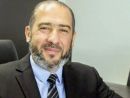
Lebanese Prime Minister Nawaf Salam **
“Trust built, national authority restored, and land liberated: that is the formula for Lebanon’s recovery.”
|
Salam at the UN: Lebanon’s Recovery Begins with Restoring Trust and Sovereignty
26/09/2026
(See translation in Arabic section)
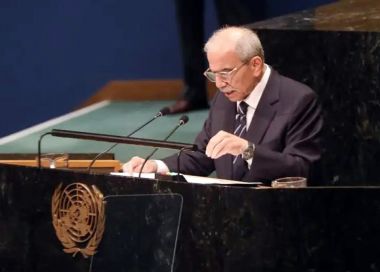
Sydney-Middle East Times Int'l: – Lebanese Prime Minister Nawaf Salam outlined his government’s vision for restoring the state before the 81st session of the United Nations General Assembly. He said domestic reform, the state’s exclusive control over weapons, and Israel’s withdrawal from Lebanese territory were closely connected goals.
Salam said Lebanon faced three defining challenges: regaining public trust after the financial collapse and the Beirut port explosion; restoring national authority so that no power stands above the state; and recovering its territory and exercising sovereignty throughout the country. He summed up the task as building trust, restoring national authority and liberating land.
Referring to the session’s theme, “Restoring Trust and Managing Change,” Salam criticised the selective application of international law. He argued that respect for sovereignty and the protection of civilians must not depend on differing standards. He called for greater investment in conflict prevention and development, as well as a fairer international economic system that helps developing countries pursue reform instead of leaving them to face debt and poverty alone.
Salam also addressed climate change, calling for fair funding to help vulnerable countries adapt to its effects and gain access to technology. He said artificial intelligence offered significant opportunities but required international governance to protect human rights and privacy and prevent a new divide from widening existing inequalities in wealth and development.
Turning to Lebanon, he said the wound left by the Beirut port explosion remained open and could not heal without truth, justice and accountability. He acknowledged that his government had yet to fulfil all its pledges, while pointing to the scale of the crises it had inherited: paralysed institutions, a weakened administration, economic decline and the effects of longstanding foreign interference.
He said the government had begun reforms to improve public administration, strengthen judicial independence, update the media law and abolish the death penalty. It was also working to complete financial reforms aimed at restoring order to the financial system and recovering deposits. Salam said an agreement with the International Monetary Fund would help rebuild international confidence and secure funding for economic recovery and reconstruction.
On sovereignty, Salam insisted that decisions on war and peace must rest solely with Lebanon’s constitutional institutions and that only the state should possess arms. Although Lebanon is affected by crises around it, he said, it must not again become an arena for other countries’ conflicts or a bargaining chip in their negotiations. Only the Lebanese state, he stressed, can speak and negotiate on the country’s behalf.
Salam called for an end to the war and a lasting ceasefire, Israel’s withdrawal from all Lebanese territory up to the internationally recognised border, the release of prisoners, and the safe return of residents to their villages and towns. He also urged the reconstruction of war-damaged areas, saying that recovering land means little unless its people can return to their homes, livelihoods and communities.
He said the three-party framework reached through negotiations rested on two principles: Israel’s withdrawal and the extension of Lebanese state authority across the entire country. Its implementation, he said, must proceed through reciprocal, phased steps under a clear timetable, with a mechanism to verify that every commitment is met.
Salam praised the work of the United Nations Interim Force in Lebanon, or UNIFIL, but warned of a possible security and monitoring gap after its operations end and its troops gradually withdraw. He called for agreement on an international force that could continue monitoring, reporting and liaison duties. He also sought continued humanitarian assistance and funding for early recovery and the reconstruction of southern Lebanon, so displaced residents can return in safety and dignity.
Salam cited UN Security Council Resolution 1701 and the Taif Agreement as key references for extending state authority. Lebanon, he said, accepts responsibility for reform and for implementing its decisions, while the international community must also help ensure respect for Lebanese sovereignty and compliance with international resolutions. Reconstruction would require support for homes, public facilities, infrastructure and productive sectors, alongside assistance for those whose basic needs remain unmet.
On regional issues, Salam reaffirmed the Palestinian people’s right to self-determination and warned that undermining UNRWA would deepen refugees’ suffering and increase the burden on host countries. He expressed Lebanon’s solidarity with Gulf states and Jordan in the face of Iranian attacks and the threats they pose to maritime navigation, supply chains and prices.
Salam concluded by calling for Security Council reform and broader representation, particularly for Africa and the Arab world. He also urged restrictions on the use of the veto in cases involving genocide, war crimes and crimes against humanity, arguing that the United Nations must regain public trust in its ability to deliver justice and peace. |