|
|
|
| Egypt’s China Pivot: Power, Partnerships and the Risk of War |
** “Egypt’s strength lies in turning wider partnerships into sovereign choices—and using those choices to prevent war.”
|
Egypt’s China Pivot: Power, Partnerships and the Risk of War
3/09/2026
(See translation in Arabic section)
Sydney-Middle East Times Int'l:The tensions between Türkiye and Israel, and Egypt’s regional role, increasingly reflect changing relationships between Middle Eastern states and major powers.
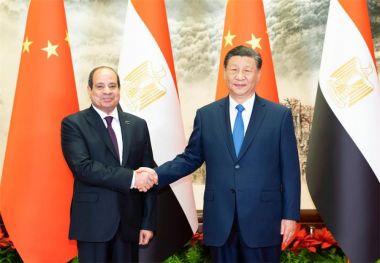
The Cairo summit between President Abdel Fattah El-Sisi and President Xi Jinping on 2 September 2026 added a new dimension to this landscape. Agreements to expand cooperation placed Egypt’s partnership with China alongside its relations with Washington and rapprochement with Ankara as factors shaping its strategic position. Egyptian Presidency
However, the summit does not establish an Egyptian–Turkish–Chinese military axis against Israel. A more grounded assessment is that Cairo seeks greater freedom of action by diversifying its partnerships.
Strategic Cooperation, Not a Defence Guarantee
The joint communiqué strengthened the comprehensive strategic partnership established in 2014, covering political coordination, security, counterterrorism, industry, technology, energy and local-currency transactions.
Both countries rejected Palestinian displacement, supported a two-state solution and affirmed the primary responsibility of coastal states for Red Sea security.
Crucially, the published text contains no provision treating an attack on either country as an attack on the other. It therefore provides no basis for assuming a Chinese defence umbrella over Egypt or a commitment to confront Israel or the United States. Joint Communiqué
Cairo Expands Its Options
Egypt can pursue Chinese investment and technology while retaining its Western relationships. This approach may strengthen its negotiating position without removing the economic and military constraints on its foreign policy.
Described as “strategic balance”, the policy seeks broader international options while Egypt remains an important US defence partner. It should not be reduced to a straightforward shift from Washington to Beijing. Reuters
The visit also advanced cooperation in manufacturing, renewable energy and the China–Egypt industrial zone within the Suez Canal Economic Zone. Anadolu Agency
Successful projects could strengthen Egypt’s economic resilience. But agreements require financing, implementation and meaningful technology transfer before they translate into national strength. Greater Chinese investment may increase Beijing’s interest in Egyptian stability without creating a willingness to fight for it.
Implications for Israel
Egypt’s wider international relationships could raise the political cost of escalation affecting its security or vital interests. They may help Cairo mobilise diplomatic support and withstand pressure.
These effects remain primarily political and economic. The summit does not establish a new Chinese-led military front against Israel, nor does it itself alter the 1979 Egyptian–Israeli peace treaty.
Cairo’s security decisions remain grounded in its assessment of threats to its borders, Sinai and national interests. The partnership expands its options without signalling a decision to enter a confrontation.
Syria Remains a Flashpoint
Turkish–Israeli friction in Syria remains a potential source of unintended escalation. Military operations could affect Turkish personnel or equipment, prompting retaliation and counterstrikes.
Following Israeli strikes on Abu al-Duhur airbase, US envoy Tom Barrack announced efforts on 18 August to establish a mechanism to prevent clashes involving Türkiye, Israel and Syria. This demonstrates the practical importance of military communication. Reuters
Nevertheless, the possibility of an incident does not make war inevitable. Conflicting interests can coexist with arrangements that prevent direct confrontation.
Separate Partnerships, Separate Obligations
Saudi Arabia, Türkiye and Pakistan signed the Mecca Joint Defence Agreement on 7 August, treating an armed attack on one as an attack on all. Reuters
That agreement should not be merged analytically with Egypt’s Chinese partnership. Each framework has separate participants and commitments. Possible Egyptian membership must remain a possibility until officially announced.
Similarly, Türkiye’s NATO membership does not make every clash involving Turkish troops an automatic trigger for alliance warfare. The treaty defines geographical limits, while allies determine the assistance they consider necessary. An attack on Turkish territory differs from an incident involving Turkish forces inside Syria. North Atlantic Treaty
Gaza and Maritime Security
The Cairo talks supported de-escalation, diplomatic solutions, implementation of the second phase of the Gaza agreement and humanitarian assistance. This gives the partnership potential value as an instrument of conflict containment. Egyptian Presidency
Coordination could strengthen opposition to Palestinian displacement and international support for Egyptian diplomacy.
In the Red Sea, Egypt’s interest in stable shipping intersects with China’s commercial priorities. This may encourage cooperation, but it does not establish an agreement to deploy Chinese troops or create bases in Egypt.
Three Possible Paths
The emerging partnerships could strengthen deterrence and negotiation, helping states protect their interests while avoiding confrontation.
Alternatively, a limited clash—particularly in Syria—could require urgent mediation. The most dangerous scenario would involve simultaneous crises across several theatres and the failure of communication channels to contain them.
None of these possibilities automatically constitutes a world war. That would require a substantial expansion of direct military confrontation among major powers, which the Egyptian–Chinese partnership does not establish.
The Cairo summit’s real test is whether broader cooperation helps Egypt protect its security, support development and prevent escalation.
The greatest danger is mistaking political support for a guarantee of military intervention. Egypt’s strongest position will come from partnerships that preserve independent decisions and help prevent a war whose consequences no participant could fully control. |
|
|
|
|
|