|
|
|
| Aoun in Athens: A Lebanese–Greek Partnership to Protect Sovereignty and Consolidate Peace in the Eastern Mediterranean |
** “Lebanon seeks a peace protected by the state—beginning
with the withdrawal of the occupation and completed by the army’s
exclusive authority over the entire country.”
|
Aoun in Athens: A Lebanese–Greek Partnership to Protect Sovereignty and Consolidate Peace in the Eastern Mediterranean
27/08/2026
(See translation in Arabic section)
Sydney-Middle East Times Int'l: Lebanese President General Joseph Aoun’s visit to Greece on 31 August 2026 marked a significant diplomatic milestone in his international engagement. In Athens, he presented Lebanon’s vision for addressing its sovereignty and security challenges while seeking broader European support and stronger bilateral cooperation in the political, military and economic fields.
The visit carried particular importance given Greece’s position within the European Union and the Eastern Mediterranean, its current membership of the United Nations Security Council, and its preparations to assume the presidency of the European Union in January 2027.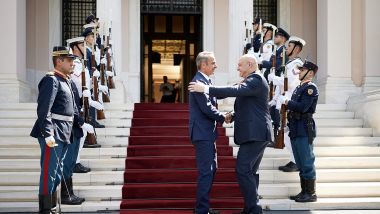
President Aoun arrived at Athens International Airport, where he was welcomed by Greek Foreign Minister George Gerapetritis, Greek Ambassador to Lebanon Despina Koukoulopoulou, Lebanese Ambassador to Greece Kinga Al Hajal and members of the Lebanese Embassy.
Accompanied by the Greek Foreign Minister, Aoun proceeded to the Tomb of the Unknown Soldier in Syntagma Square, where he laid a wreath. The Lebanese and Greek national anthems were played before the President inspected the guard of honour.
Gerapetritis’ reception of the Lebanese President reflected the political importance Athens attached to the visit and provided an opportunity to exchange views on bilateral relations and regional developments ahead of the formal talks.
Aoun–Tassoulas Summit: Diplomacy as an Alternative to War
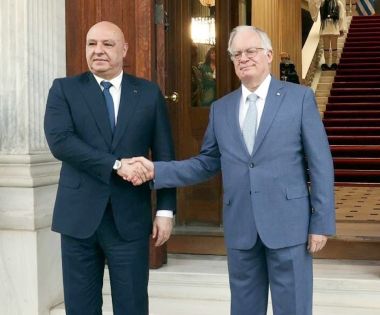
At the Presidential Palace, Aoun held talks with Greek President Constantine Tassoulas. The discussions focused on the two countries’ historic relations and ways to develop them, as well as the situation in southern Lebanon, the implementation of UN Security Council Resolution 1701 and the negotiating process aimed at ending the state of hostility.
Aoun stressed that Lebanon was committed to peace and that military action had failed to produce a solution. He maintained that diplomacy remained the most effective path for resolving conflicts.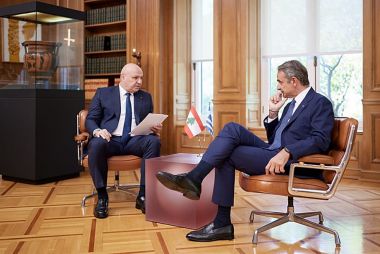
Aoun asked Greece to support this process, emphasising that Lebanon’s stability was not merely a Lebanese necessity but was also essential to the stability of the Eastern Mediterranean, Greece and Europe.
He pointed to the heavy loss of life and widespread destruction suffered by dozens of Lebanese villages, arguing that people could not remain permanently trapped in recurring cycles of war.
For his part, President Tassoulas reaffirmed Greece’s support for Lebanon’s independence and sovereignty and expressed his country’s backing for Aoun’s efforts to build peace and consolidate state authority.
He announced that Greece would use its presidency of the European Union, beginning in January 2027, to strengthen relations between Lebanon and the EU and advance them towards a more comprehensive level.
Tassoulas also referred to Greek military assistance that had arrived at Beirut Port shortly before the visit, describing it as practical evidence of the strength of bilateral relations and Greece’s readiness to continue supporting the Lebanese state and army.
Meeting with Mitsotakis: Sovereignty and the State’s Monopoly on Arms
President Aoun’s meeting with Greek Prime Minister Kyriakos Mitsotakis produced the clearest positions regarding Lebanon’s future.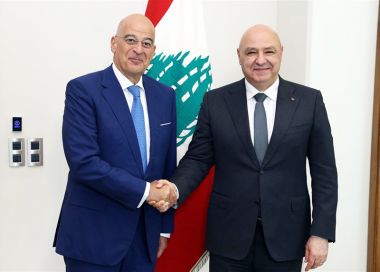
He stressed that both crises must be addressed “concurrently, simultaneously and in parallel”—through a complete Israeli withdrawal and the exclusive deployment and authority of the Lebanese Armed Forces across the entire country.
Aoun sought continued Greek support for Lebanon at the United Nations, particularly in securing an international role to assist the country following the end of the United Nations Interim Force in Lebanon’s mission in the South.
He also requested Greek support in Washington, where Lebanon is pursuing its negotiating track, and within the European Union, with which Beirut hopes to establish a strategic partnership.
Mitsotakis declared Greece’s unequivocal support for Lebanon’s sovereignty, independence and unity, praising President Aoun’s decision to invest in diplomacy and negotiations.
He affirmed that Lebanon would remain a priority on the agendas of both Greece and the European Union, adding that Athens would seek to initiate the process of establishing a strategic partnership between Lebanon and the EU during its forthcoming European presidency.
The Greek Prime Minister also described the Lebanese Army as the central pillar of Lebanon’s sovereignty and security. He announced that Greece’s armed forces were prepared to increase their assistance to the Lebanese military, helping it extend state authority throughout the country, particularly in the South.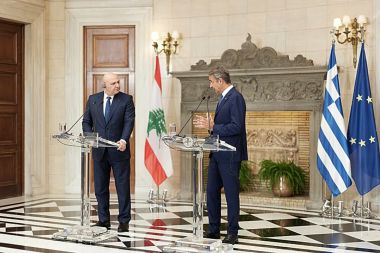
The discussions were not limited to political and security matters. They also explored opportunities to increase investment and trade and strengthen cooperation in tourism, culture, archaeology, energy and infrastructure, as well as Greece’s potential participation in Lebanon’s reconstruction.
President Aoun proposed twinning several Lebanese and Greek coastal cities, drawing on the shared civilisational heritage of the Phoenicians and ancient Greeks.
Both sides agreed that, once Lebanon restores its stability and state sovereignty, it could help transform the Eastern Mediterranean from an arena of tensions and conflict into a region of cooperation, peace and prosperity.
The Wider Significance of the Visit
The Athens visit extended well beyond the framework of conventional bilateral relations. Lebanon is seeking to use its relationship with Greece to advance three parallel objectives: securing European and international support for state authority, obtaining additional assistance for the Lebanese Army, and transforming historic Mediterranean ties into an economic and strategic partnership.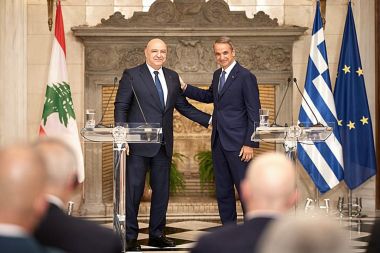
Greece’s membership of the UN Security Council and its forthcoming presidency of the European Union also provide Lebanon with two important diplomatic channels at a highly sensitive stage.
President Aoun returned to Beirut later that evening after completing his talks with the Greek President and Prime Minister. He carried with him Greek commitments to support Lebanon politically and militarily and to advance bilateral relations towards a broader partnership founded on sovereignty, stability and peace. |
|
|
|
|
|