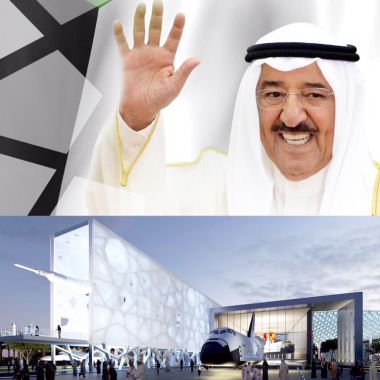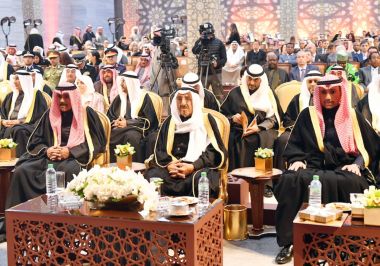
Kuwait's cultural strategy aimed at highlighting the importance of culture in building societies through spreading tolerance, love, peace and acceptance of the other HH The Amir of Kuwait inaugurates Sheikh Abdullah Al Salem Cultural Center 5/2/2018 Translated and Edited by the ME Times Int'l (Translation appears in Arabic section) His Highness the Amir Sheikh Sabah Al-Ahmad Al-Jaber Al-Sabah inaugurated the Sheikh Abdullah Al-Salem Cultural Center at Shaab Area on the 5th February 2018. His Highness the Amir was received upon his arrival by Minister of Amiri Diwan Sheikh Ali Jarrah Al-Sabah and Director of Financial and Administrative Affairs at Amiri Diwan Abdulaziz Ishaq. 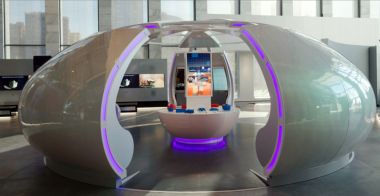
Sheikh Ali, addressing the ceremony, said Sheikh Abdullah Al-Saleh Cultural Center was a scientific, cultural and historic monument, which displayed the past and present as well as illustrated a future vision. The center was named after late Amir Sheikh Abdullah Al-Salem Al-Sabah "the founder of modern development of our beloved nation," he said. The center, said Sheikh Ali, was implemented by the Amiri Diwan and subjected to legal and auditing scrutiny. Sheikh Abdullah Al-Salem Cultural Center, to be run by trained Kuwaitis, is an addition to the development of civilized projects implemented under the rule of His Highness the Amir, added Sheikh Ali. The minister thanked the Ministries of Education and Information for their important contributions to the center. 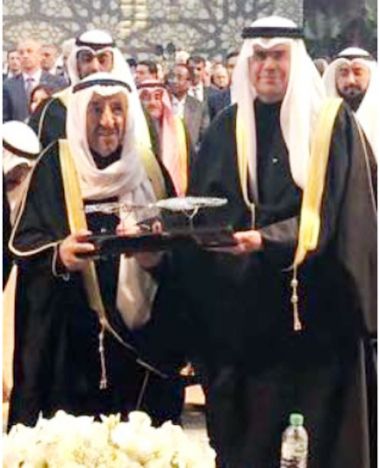
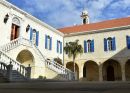
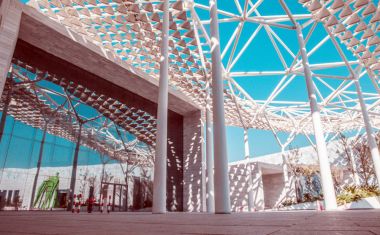
During the inauguration The inauguration ceremony was attended by His Highness the Crown Prince Sheikh Nawaf Al-Ahmad Al-Jaber Al-Sabah, Parliament speaker Marzouq Al-Ghanim, Sheikh Jaber Abdullah Al-Sabah, Sheikh Faisal Al-Saud Al-Sabah, His Highness Sheikh Nasser Mohammad Al-Ahmad Al-Sabah, His Highness the Prime Minister Sheikh Jaber Mubarak Al-Hamad Al-Sabah, Sheikh Ali Al-Jarrah, Deputy Premier and Foreign Minister Sheikh Sabah Khaled Al-Hamad Al-Sabah, GCC Secretary General Abdullatif Al-Zayani, Deputy Premier and Interior Minister Sheikh Khaled Jarrah Al-Sabah, Deputy Premier and Minister State for Cabinet Affairs Anas Al-Saleh, senior government, GCC and military officials. Architectural Design Abdullah Al-Salem Cultural Center combines the beauty of its architectural design and its cultural role, making it an important monument reflecting the modern aspect of Kuwait. The opening of the center is in line with His Highness the Amir’s vision to highlight the bright cultural face of Kuwait and restore its cultural leadership in the region. 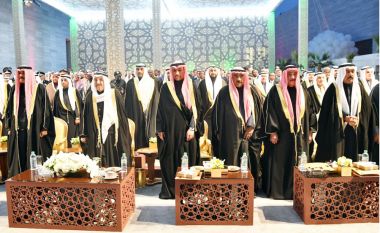
During the inauguration Kuwait relies upon this cultural center for a clear cultural and civilization impression, along with other cultural centers and projects that have been distributed in the country such as the Jaber Al-Ahmad Cultural Center, as well as the hosting of many cultural events which culminated in the selection of Kuwait as Capital of Islamic Culture for 2016. The completion of this great edifice aims to highlight the scientific and cultural achievements, Kuwait’s history as well as the history and culture of the Islamic and Arab world and the world cultural achievements. The aesthetic outside design of Abdulla Al Salem Cultural Center attracted attention before its inauguration. The Abdulla Al Salem Cultural Center won in September 2017 the prestigious l’iF Design Award for the Public Enterprise Sector. It is one of the most prestigious awards in the world of architecture which recognizes outstanding projects 16 years ago and is considered a benchmark for the future of the industry. 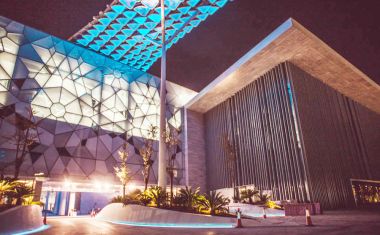
During the inauguration The Center is one of the largest exhibition areas in the region and the world. It is built on a total area of about 127,000 square meters with an area of 30,000 square meters and gardens over 97,000 square meters in a strategic location. The total built area (two basements and three floors) is 123,500 square meters. The Center was built over the Abdullah Al-Salem old school that was a beacon of science and today the Center is today's cultural and creative beacon. The center is formed of eight buildings, six of which are dedicated to museums such as the Natural History Museum, the Science and Space Museum, the Islamic Museum and the Fine Arts Center in addition to the administrative building, the technology exhibition, the information center and the theater. Services include prayer halls, restrooms, entertainment and games for children and car parking. Each building includes a basement and a ground floor. Two main floors for exhibition and a theater for up to 300 people. It is an integrated center that meets the requirements of researchers and those interested in cultural and artistic matters. A shining sign promoting the culture of the country Mohammed Al-Jabri, the Kuwaiti Minister of Information and Chairman of the National Council for Culture, Arts and Literature said that the Abdullah Al-Salem Cultural Center reflects the prestigious status of Kuwait in the Arab region and the world as a shining sign promoting the culture of the country. Al-Jabri said in a press statement that His Highness the Amir of Kuwait opening of this pioneering cultural edifice, emphasized his highness’s belief in the importance of promoting the cultural centers, thus contributing to the restoration of Kuwait's leadership and position in all areas. He explained that the inauguration of this building after the opening of Sheikh Jaber Al-Ahmad Cultural Center in 2016 is a true translation of Kuwait's cultural strategy aimed at highlighting the importance of culture in building societies through spreading tolerance, love, peace and acceptance of the other. The Sheikh Abdullah Al-Salem Center, which was part of the Amiri High Vision, represents a new cultural front and is one of the proud and illustrious features of the State of Kuwait, which adds to its magnificent image, a light making it a cultural hub of great magnificence and creativity. 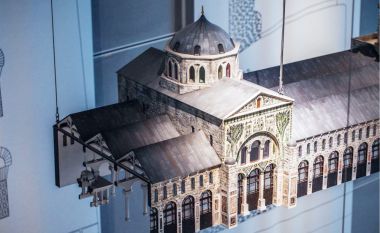
He praised the sincere efforts exerted by those in charge of this cultural edifice, headed by Sheikh Ali Al-Jarrah Al-Sabah the Minister of Amiri Diwan Affairs, Sheikh Mohammed Al-Abdullah Al-Mubarak Al-Sabah Deputy Minister of Diwan Affairs and Abdel Aziz Isaac the Head of Financial and Administrative Affairs at the Diwan, the Chairman of the Executive Committee for the establishment and management of the cultural centers of the Diwan, which lead to this cultural project appropriately to Kuwait's cultural status. Al-Jabri pointed out that the participation of ministers of culture and information in the Gulf Cooperation Council countries in this huge ceremony confirms the status occupied by the State of Kuwait at the Gulf and Arab nations. An architectural masterpiece and one of the largest museum exhibition areas in the world. Abdul Aziz Ishak the head of the financial and administrative affairs at the Amiri Diwan and Chairman of the Executive Committee for the Establishment and Management of the Cultural Centers of the Diwan said that Abdullah Al Salem Cultural Center is an architectural masterpiece and one of the largest museum exhibition areas in the world. In a press statement, Ishak pointed out that the establishment of this cultural edifice came under the supreme Emiri directives to promote the bright cultural face of the State of Kuwait and to emphasize its cultural leadership in the region through the attention given to cultural and educational aspects. He added that the opening of the center was also part of the supreme Amiri vision aimed at opening up to international cultures and technological developments and creating a state of cultural, entertaining and educational dialogue in order to develop cultural capacities and concepts and enrich culture and education in the development of human thought. “The center is an “architectural masterpieceâ€, a historical added value and a continuation of the Kuwaiti cultural givingâ€, he said. The inauguration ceremony coincided with the celebrations of the State of Kuwait’s national holidays. It confirms that the State’s cultural development is due to the belief of its rational leadership in the role of culture to support civilizations and advance development in order that the State of Kuwait will be a global cultural and educational platform. 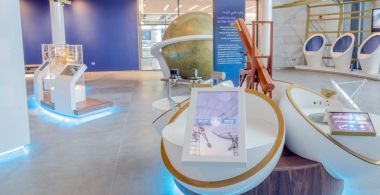
The project, which consists of six major museums, was "completed in record time" over only 20 months of construction and 18 months of museum work, including several components celebrating the scientific and cultural achievements of Kuwaiti history as well as the history and culture of the Arab and Islamic worlds. He pointed out that the design of the center exterior has "a beautiful aesthetic character that suggests artistic and cultural miracle to the visitor." The center includes 8 buildings containing six museums, including a museum of natural history, space sciences, Arab Islamic sciences and another one for science. The center includes a building for archive, a conference room, a theater for 300 people, a public services building, an information center and a car park with 1231 cars, with 1,083 cars in the basement and 148 vehicles in the ground floor, he explained. He pointed out that the center contains the general area exhibition, which is distributed among museums and 25 water fountain and jet fountains around the outer perimeter of the buildings. Thus the project is "integrated in all aspects and meets the requirements of researchers and those interested in various cultural and artistic matters." 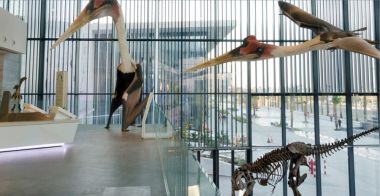
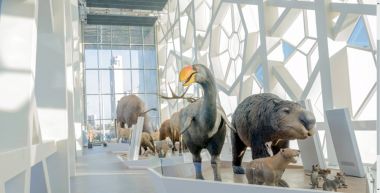
The center occupies a “very special strategic location†which is Abdullah Salem School. This school was a beacon of science and now the center is a beacon of culture, a cultural center, a social center and a center for creative people," he said. As for the museums, Ishak pointed out that the museums (E) and (B) are about the natural history. The visitor will be acquainted with the natural history in these two museums while he will discover the history of the desert in the annexed museum. The entire museum includes areas dedicated to the school visits to allow the visitor to know the finest details of wildlife from caves to different reptiles as well as harsh ecosystems and human climatic conditions, whether in desert or polar environment in all its details. The Museum of Physical and Chemical Sciences and Transportation Science are in Building (C). It exhibits all types of transportation means and its evolution throughout history as well as physical and chemical sciences, scientific research and innovation through interactive exhibitions. The museum also includes three test labs for experiments (experiment Lab) on the ground floor of the south side, a sailing laboratory, and another one for aerodynamics on the northern side of the ground floor, as well as a work place in the second floor on the northern side, Ishak added. 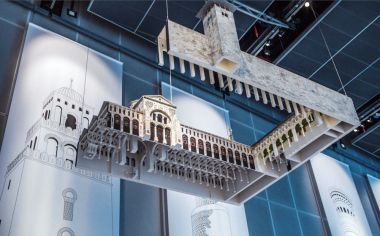
The museum consists of two floors. The ground floor exhibits the history of aviation, while the first contains the robots and artificial intelligence exhibition in addition to physical and chemical experiments, while the second floor was dedicated to innovation. As for the Museum of Science (Building D), Ishak said that it shows the human body with sculptures of different organs, bacteria and viruses, and presents different exercises that must be performed by humans to stay healthy. It also includes a laboratory dedicated to biology experiments on the first floor of the southern side. About the Museum of Arab Islamic Sciences (Center of Fine Arts) Building (E) Ishak said it is full of exhibits, interactive touch screens, films and planning. 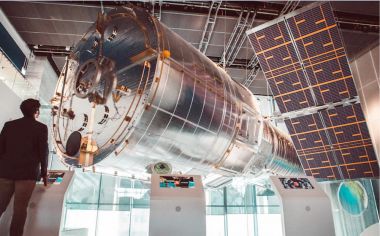
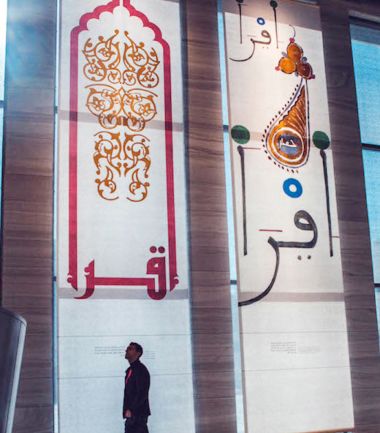
The main part of the museum is a high area containing models of mosques hanging above the heads of visitors that can be seen from the level of mezzanine indicating that the visitor will be informed during his visit to this museum about the golden age of Arab science when important discoveries that changed the world forever were made. The museum located in the south of the center is distributed between the ground floor and the first floor and focuses on the most important arts, inventions and discoveries that were famous by the Arabs during the Islamic era between the 8th and 15th century AD. It highlights also the role of Islam and the Koran and Muslims in encouraging Arabs to search for culture and science and their role in the development of several patterns of different sciences, he explained. 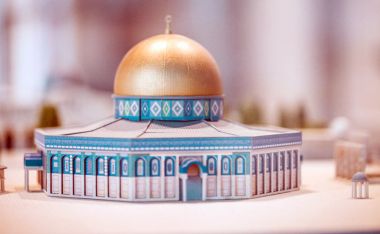
The Outer Space Museum (Building F), which exhibits the outer space and its exploration by humans through space missions. There are exhibitions of various types of space ships and a celestial dome, Ishak said. The museum consists of three main exhibitions connected to each other, the first of which is about planetary science, the second on space academy and the third for space exploration. Ishaq added that this edifice includes many of the external exhibits, including the dinosaur structure and the fossil areas, consisting of two dinosaurs’ skeletons and a corridor showing the traces of the series of prehistoric life in addition to a sandy basin showing how to explore the dinosaurs’ traces. He pointed to the sculpture of a flock of birds providing shade and adding to the subject of wildlife contrary to other mobile sculptures moving by wind and solar radiation. 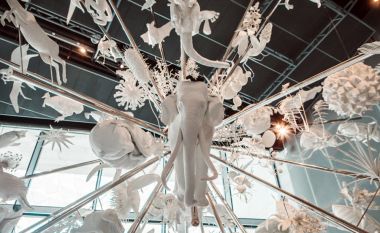
|