| Messi’s Tears and Spain’s Tactical Masterpiece |
|

Messi’s Tears and Spain’s Tactical Masterpiece
New York — Cesar Chelala
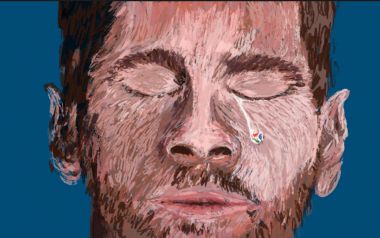
Lionel Messi cried at the end of the World Cup final, and much of the soccer loving world cried with him. The image was arresting: a player who has spent two decades bending the sport to his will suddenly undone by its most ordinary cruelty — defeat. But the emotion was not only about losing a match. It was the visible expression of a superstar confronting his own limits, and of a team unable to free him from a tactical vise designed expressly to control him.
This final was Messi’s chance to claim a second World Cup, a crowning achievement that would have placed him alone in the sport’s highest stratosphere. It was also a match in which he could not help his teammates — not because he lacked desire, but because Spain denied him every situation he needs to be Messi.
Spain’s plan was not subtle; it was suffocating. Whenever Nahuel Molina or Cristian Romero tried to find him on the right flank, Nico Williams sprinted back to double team, Dani Carvajal stepped forward with sharp aggression, and Rodri slid diagonally to seal the inside channel. The triangle that has long defined Argentina’s rhythm — Messi, Rodrigo De Paul, Julián Álvarez — never formed. The geometry was broken before the ball arrived.
Spain’s coach, Luis de la Fuente, also understood that Messi, at 39, remains dangerous only in specific zones. They allowed him to drop into midfield, knowing that deep Messi is almost harmless. Although he could touch the ball, he could not turn, accelerate, or thread the long diagonal that changes matches. Each time he drifted downfield, Spain stayed compact. No one followed him. He received the ball too far from goal, with too little time, and with no angles to exploit.
The message was unmistakable: You can touch the ball, but you cannot hurt us. Spain didn’t stop the player; they stopped the ecosystem that makes the player possible. They removed time, not space. And for Messi, time is the raw material of genius.
This is not the Messi of his early years, the one Uruguayan writer Eduardo Galeano described with mystical delight. Galeano once wrote that Messi seemed to have “the ball inside his foot,” an unintelligible phenomenon that defied physics and made defenders look foolish for searching in the wrong place. That Messi still appears in flashes, but the sport has changed, and so has he.
What remains constant is the affection Messi inspires. In African villages and Asian cities where I have worked, children wear Argentina’s No. 10 jersey with a devotion that borders on reverence. During this World Cup, his shirt was the most common sight in stadiums across continents. Zinedine Zidane has called Messi “magic.” Gianluigi Buffon, the Italian goalkeeper, once said Messi was “an alien who dedicates himself to playing with humans.” Yet watching him cry after losing the most important match of his life, one saw none of the alien, none of the magic — only a man confronting the end of something extraordinary.
Messi’s tears reminded the world that even the most gifted athlete of his generation is, in the end, human — and that even legends reach nights when the game refuses to bend.
Cesar Chelala, a New York writer, is a 2014 winner of the best sports article from the Argentine Association of Newspapers Editors (ADEPA,) and a co-winner of an Overseas Pres Club of America award.
Illustration by Paola Bilancieri
|









.jpg)