|
|
|
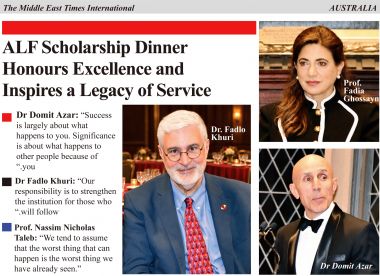
| ALF Scholarship Dinner Honours Excellence and Inspires a Legacy of Service |
**
Dr Domit Azar: “Success is largely about what happens to you. Significance is about what happens to other people because of you.”
**
Dr Fadlo Khuri: “Our responsibility is to strengthen the institution for those who will follow.”
**
Prof. Nassim Nicholas Taleb: “We tend to assume that the worst thing that can happen is the worst thing we have already seen.”
|
ALF Scholarship Dinner Honours Excellence and Inspires a Legacy of Service
10/11/2026
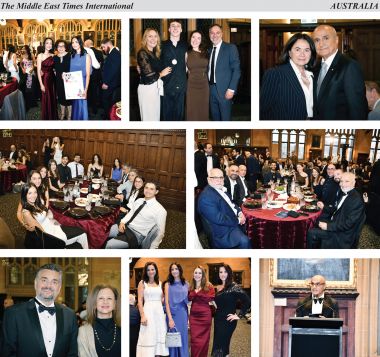
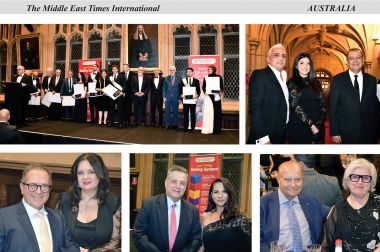
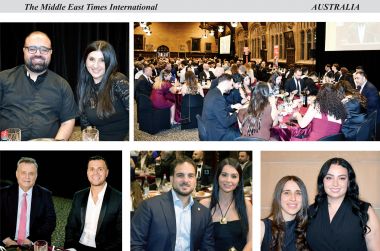
Sydney-Middle East Times Int'l: The Australian Lebanese Foundation proudly held its 2026 annual awards ceremony to honour outstanding students, bringing together distinguished guests from academia, government, diplomacy, business and the community.
Attendees included American University of Beirut President Dr Fadlo Khuri; Professor Nassim Nicholas Taleb; University of Sydney Chancellor David Thodey; Minister Jihad DibMP; H.E Lebanese Ambassador Myrna Khawly; H.E Ambassador Charbel Macaron; Lebanese Consul-General H.E Raymond El Chamlati; Lebanese Consul Sarah Dirani; Canterbury-Bankstown Deputy Mayor Cr. Rachelle Harika; Episcopal Vicar Monsignor Marcelino Youssef; Superior of St Charbel’s Monastery Father Assaad Lahoud; Father Anthony Kazzi; Chamber of Commerce President Salim Nicolas AM, Arab Bank Australia Managing Director Dr. Joe Rizk AM; businessman Sarkis Nassif, President of the Sydney–Australia chapter of the Maronite Foundation in the World for Integral Development; Charlie Assaf of Montessori Academy; Australian Lebanese Christian Council President and journalist Camil Shalala; businessmen Danny Nicolas, AM, Richard Andary and Anthony Sukari, AM Dr Jamal Rifi; and Dr Anthony Hachem, AM.
Dr Elie Matar served as master of ceremonies, with the musical ensemble from St Patrick’s College, Strathfield, opening the evening.
The Foundation’s Honorary President, Professor Fadia Ghossayn Bou Dagher, delivered the opening address, followed by Chancellor David Thodey and Foundation’s President Dr Domit Azar. Andrew Coorey moderated a conversation with Professor Nassim Nicholas Taleb.
Scholarships and certificates of recognition were presented to Alex Ainati of St Charbel’s College; Christa Nicole Kahdemar of Our Lady of Mercy College, Parramatta; Otel Haddad of St Patrick’s College, Strathfield; Salam Khalil of St George Girls High School, Kogarah; and Youssef Tannous of St Andrew’s, Mittagong.
Awards for sporting and dance achievements went to Clara Shalala for hip-hop, Nicholas Oweijan for taekwondo, Luke Nassif for boxing and Mohamad Ali Dib for dance.
Mrs Lara Salim Nicolas also received a certificate of appreciation for her continued support of educational and community activities.
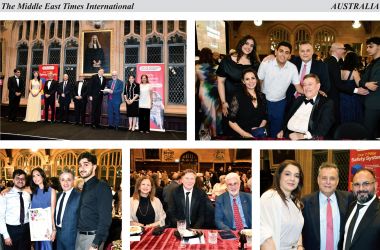
Foundation Honorary President Professor Fadia Ghossayn Bou Dagher, AM, thanked committee members, supporters and friends for turning a shared vision into opportunities for young people.
She said the greatest legacy lay in inspiring hope and creating opportunities for others. Addressing scholarship recipients, she emphasised that each award represented more than financial assistance: it expressed confidence in their potential.
She encouraged recipients to turn their achievements into opportunities for others, reaffirming the Foundation’s belief in education, young people and community solidarity.
David Thodey:
University of Sydney Chancellor David Thodey praised the Australian Lebanese Foundation’s longstanding contribution to education, scholarships and the University community, welcoming distinguished guests from Australia, Lebanon and the United States.
He celebrated the Lebanese community’s extraordinary contribution to Australian life and highlighted education as a powerful connection between both countries. He also paid tribute to Dame Marie Bashir, acknowledging her enduring support for the Foundation and exceptional service to public and academic life.
Thodey emphasised that universities must remain places for open dialogue, respectful exchange and engagement across cultures. Drawing inspiration from Kahlil Gibran’s The Prophet, he encouraged humility and openness to different perspectives.
Congratulating scholarship recipients across health, commerce, law and science, he urged students to embrace friendships and experiences beyond formal study, share their ideas and listen carefully to others.
Dr Domit Azar:
Dr Doumit Azar, President of the Australian Lebanese Foundation, highlighted education’s power to create opportunity, connect communities and improve lives.
Congratulating scholarship recipients, Azar acknowledged the parents, families, teachers and mentors whose sacrifices helped make their achievements possible.
He encouraged students to pursue excellence while recognising that personal success gains deeper meaning when used to benefit others.
Drawing on his recent experience performing eye surgery in rural Cambodia, Azar described restoring sight to people affected by poverty and inadequate healthcare. Despite limited resources, his education enabled him to make a profound difference.
He also recognised his wife’s sacrifice in caring for their six children during his absence, stressing that those supporting humanitarian work deserve recognition.
Azar urged recipients to share ideas, use their influence for the disadvantaged, create opportunities and help people unable to repay them.
Thanking sponsors, supporters, volunteers and the University, he emphasised that scholarships can transform lives and educational partnerships can bridge nations.
Charlie Assaf:
Charlie Assaf of Montessori Academy affirmed his support for the Australian Lebanese Foundation, highlighting the Lebanese community’s enduring belief in education.
He emphasised that keeping children safe is the first responsibility of early childhood education, arguing that recent childcare scandals exposed weaknesses despite staff holding valid clearances.
Montessori Academy’s central safeguard requires educators to remain visible to another adult when caring for children.
Assaf outlined three areas of innovation: compliance management to verify staff credentials and identify concerning patterns; vision artificial intelligence to detect potential safety risks; and humanoid robotics to support educators.
He stressed that technology must follow Montessori principles and never replace teachers. Proposed robotic applications include providing regulatory knowledge, supporting safety monitoring and assisting with documentation, allowing educators to spend more time with children.
Robots would never count towards staffing ratios or remain with children without an educator present. He concluded by introducing Luca from the Academy’s innovation program.
Dr Fadlo Khuri:
Dr Fadlo Khuri, President of the American University of Beirut, highlighted the transformative power of scholarships and education.
He recalled founder Daniel Bliss’s commitment to admitting students regardless of colour, nationality, race or religion, emphasising that education should create opportunities for all.
Khuri traced his understanding of service to his father’s belief in helping others without expecting anything in return. His career in oncology reinforced the importance of listening, compassion and understanding patients beyond their diagnoses.
Contrasting difficult professional experiences with supportive environments, he argued that leadership must combine excellence with decency, collaboration and concern for people.
Returning to AUB as president in 2015 fulfilled a lifelong ambition. His priorities included strengthening academic standards, improving facilities, engaging students and expanding international partnerships, including with the University of Sydney.
Khuri stressed that successful institutional change requires trust, consultation and shared responsibility. Leaders must explain their decisions, listen to criticism and acknowledge uncertainty.
He identified character, direction, connection and legacy as guiding principles, insisting that universities must be strengthened for future generations rather than centred on individual leaders.
Lebanon’s financial collapse, the pandemic and the Beirut port explosion threatened students’ education, staff livelihoods and patients’ access to healthcare.
** ** AUB responded by expanding financial assistance, adapting teaching and sustaining research, healthcare and medical education despite uncertainty.
Khuri emphasised that the university’s resilience belonged to its entire community. Academics, healthcare workers, students and essential staff collectively sustained its mission through extraordinary hardship.
He argued that effective leadership requires clarity of purpose, honesty, humility and a willingness to adjust decisions when evidence demands change. Universities must continue educating people, advancing knowledge and serving society, even when circumstances transform their methods.
Addressing artificial intelligence, he stressed that technological advances cannot replace human judgement. Universities must nurture curiosity, independent thinking, ethical responsibility and lifelong learning.
Khuri also highlighted the importance of mentorship and scholarships in allowing young people to overcome circumstances and realise their potential. Their contributions may ultimately benefit communities in ways donors never witness.
He thanked the Foundation and its supporters, congratulated scholarship recipients and encouraged them to build fulfilling lives through responsible citizenship, family commitments and community service.
Maritta Nassif:
Ten-year-old Maritta Nassif welcomed Professor Nassim Nicholas Taleb, celebrating their shared connection to Amioun, her family’s hometown and his hometown.
Born and raised in Sydney, Maritta described her love for Amount’s olive trees, ancient character, welcoming people and strong family spirit.
With humour, she admitted she had not finished The Black Swan and was still discovering Taleb’s ideas, but already felt inspired to think big.
Prof. Nassim Nicholas Taleb: Independent Thought in an Unpredictable World
Professor Nassim Nicholas Taleb discussed education, entrepreneurship, uncertainty and technological change, encouraging independent thought and greater respect for practical experience.
He challenged the assumption that innovation always begins with academic theory. Many discoveries, he argued, emerge through experimentation, with explanations developed afterwards. Universities should acknowledge the contributions of practitioners who discover what works through trial and error.
Taleb urged students to read beyond prescribed material, pursue curiosity and develop distinctive interests. Learning only what everyone else knows offers limited advantage; exploring unfamiliar subjects can create opportunities.
Recalling his career as an options trader, he explained that exposure to financial risk sharpened his judgment. He questioned mathematical models that underestimated exceptional events and focused on strategies that could benefit from unexpected market movements.
** ** He praised entrepreneurs because customers, competition and the possibility of failure test their decisions. Such accountability, he suggested, provides a stronger connection to reality than recognition based mainly on professional approval.
Reflecting on Lebanon’s civil war, Taleb discussed how upheaval influenced his understanding of uncertainty. He also explained that some systems become stronger through manageable stress and disorder.
He cautioned against constant news consumption, arguing that excessive information can amplify noise rather than understanding. He recommended enduring books, thoughtful conversation and ideas likely to remain valuable for decades.
Discussing the Lindy effect, he suggested that longstanding books, practices and professions may demonstrate resilience, including as artificial intelligence transforms society.
Taleb warned that future crises can exceed anything previously experienced. Preparing only for familiar disasters leaves people vulnerable to larger surprises.
He also defended fiction’s ability to reveal human truths, questioned biases in historical accounts and encouraged repeated reading. He recommended works exploring everyday life in earlier societies, emphasising curiosity, practical judgement and intellectual independence when navigating an unpredictable world.
Mohamad ‘Ali’ Dib: Giving Back and Welcoming a New Generation
Mohamad ‘Ali’ Dib highlighted the Australian Lebanese Foundation’s commitment to recognising excellence and encouraging community service among young Australians of Lebanese heritage.
He acknowledged an early scholarship recipient who, despite demanding responsibilities as a doctor, researcher and father, continues to give back to the community.
Dib linked that example to his own experience. Decades earlier, community support enabled him to travel overseas to study computer science, an opportunity unavailable to him in Lebanon. That assistance inspired him to join the Foundation about 20 years ago.
Dib warmly thanked guests, sponsors and scholarship supporters for making the evening possible. He welcomed younger volunteers who contributed to organisation, logistics, ushering and media.
Having stepped into an advisory role, he expressed gratitude that a new generation was helping carry the Foundation’s work forward and supporting its continuing mission. |
|
|
|
|
|