|
|
|
| “Washington’s challenge is no longer merely supporting its allies, but deciding how far America is prepared to travel with them into wars that have no clear ending.” |
** Netanyahu wants guarantees that Iran will not be able to rebuild its nuclear facilities, its ballistic missile program, or its regional military networks. ***
The Iranian war is reaching a dangerous crossroads. ***
The security of the Strait of Hormuz has become one of the most pressing concerns. ***
Israel views Tehran as the center of a regional network that stretches across Iraq, Syria, Lebanon, Yemen, and the Palestinian territories .***
Weakening Iranian influence does not necessarily lead to regional stability. ***
Lebanon is likely to be central to any broader understanding between the United States and Israel. ***
The danger is that Lebanon could become a secondary battleground in negotiations between Washington, Israel, and Iran.
|
“Washington’s challenge is no longer merely supporting its allies, but deciding how far America is prepared to travel with them into wars that have no clear ending.”
28/07/2026
(See translation in Arabic section)
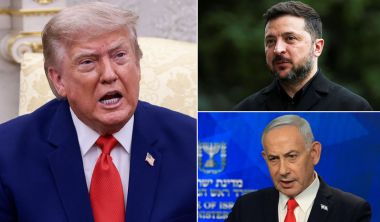
Sydney-Middle East Times Int'l: US President Donald Trump held separate White House meetings with Ukrainian President Volodymyr Zelenskyy and Israeli Prime Minister Benjamin Netanyahu, bringing two major wars and a wider network of international crises to the centre of American diplomacy.
Both leaders were in Washington to attend the funeral of Republican Senator Lindsey Graham, one of the strongest supporters of Ukraine and Israel and a prominent advocate of an assertive American role abroad.
The symbolism was striking. As Washington mourned a senator who had repeatedly placed Ukraine and Israel at the centre of foreign-policy debate, two embattled leaders arrived seeking support from the same president.
Before the funeral service, Trump welcomed Zelenskyy and Netanyahu in meetings held within minutes of each other. White House press secretary Karoline Leavitt described both discussions as “positive and productive,” although few details emerged from the private talks.
Behind the diplomatic language were difficult questions over weapons, negotiations, Russia, Iran and the future limits of American military power.
Zelenskyy presses for stronger air defences
Zelenskyy described his meeting with Trump as “good” and thanked the United States for its continuing support.
He said the talks included licences for the production of Patriot interceptor missiles, as well as other proposals designed to strengthen Ukraine’s defence against Russian attacks.
For Kyiv, additional Patriot systems and interceptors are essential to protect cities, electricity networks, military installations and civilians from ballistic missiles, cruise missiles and attack drones.
The discussions also focused on reviving diplomacy as efforts to negotiate an end to the war remain stalled. Ukraine reportedly expects Trump’s special envoys Steve Witkoff and Jared Kushner to visit Kyiv as part of renewed diplomatic activity.
However, Zelenskyy continues to insist that diplomacy cannot be separated from security.
Ukraine fears that negotiations conducted mainly between Washington and Moscow could produce an agreement that limits Ukrainian sovereignty, rewards Russian territorial gains or leaves the country vulnerable to another offensive after a temporary pause.
Kyiv is therefore seeking more than immediate military assistance. It wants long-term guarantees that Russia will not be allowed to rebuild its forces and resume the war under more favourable conditions.
Zelenskyy is also pressing for stronger sanctions against Moscow, particularly measures intended to reduce the revenues financing Russia’s military campaign.
A changed atmosphere with Trump
The mood surrounding Zelenskyy’s latest White House visit appeared different from earlier encounters with Trump, which were overshadowed by public disagreements over military assistance, gratitude, negotiating strategy and possible concessions.
This time, Zelenskyy arrived with a clearer agenda and greater confidence.
Trump continues to promote negotiations with Russian President Vladimir Putin, while Zelenskyy fears Moscow could use diplomacy to secure territorial gains, reduce international pressure and prepare for another phase of war.
Ukraine’s central task is to convince Trump that Russian military pressure—not Kyiv’s refusal to surrender territory—remains the main obstacle to peace.
Netanyahu faces a more difficult meeting
Netanyahu’s meeting with Trump carried a different tone.
It was the first face-to-face encounter between the two leaders since the United States and Israel launched strikes that ignited the Iran war.
The meeting lasted about 90 minutes and was officially described as positive. However, the relationship has come under strain as the conflict continues without a decisive conclusion.
Netanyahu wants guarantees that Iran will not be able to restore its nuclear facilities, ballistic-missile programme or regional military networks.
Israeli officials fear that any diplomatic pause could allow Tehran to reorganise, repair damaged installations, move sensitive materials and rebuild military capabilities weakened during the fighting.
Trump, by contrast, appears increasingly concerned about the risks of an open-ended conflict.
A prolonged war could require repeated American strikes, expose US forces and bases to retaliation, disrupt energy markets and deepen domestic political pressure.
Israel regards continuing military action as necessary to force Tehran into major concessions. Trump appears to see military pressure mainly as a means of bringing Iran back to negotiations.
Iran war reaches a dangerous crossroads
The Trump-Netanyahu meeting followed nearly two weeks of intensified American attacks on Iranian targets and Iranian retaliation against US forces and facilities in Gulf countries.
After 13 consecutive nights of US strikes, fighting appeared to ease for several nights, raising hopes that negotiations might resume.
US Ambassador to the United Nations Mike Waltz said Trump was giving diplomacy “some space,” suggesting Washington wanted to test whether the temporary calm could become a genuine opening.
But reduced military activity does not mean the crisis has been resolved.
Iran wants an end to attacks on its territory, protection for its remaining nuclear and military infrastructure, and relief from sanctions.
The United States wants guarantees that Tehran will not acquire nuclear weapons, threaten American forces or disrupt international shipping.
Israel is demanding stronger conditions, including restrictions on Iran’s missile programme, controls over enriched uranium and limits on support for armed organisations across the Middle East.
These competing demands make a comprehensive agreement extremely difficult.
Trump must find a formula that allows Iran to claim it defended its sovereignty while providing Washington and Israel with credible, verifiable security guarantees.
Any agreement would also have to address the central disputes that have repeatedly prevented a settlement: uranium enrichment, international inspections, ballistic missiles, economic sanctions and Iran’s support for allied armed organisations.
Iran is unlikely to accept terms that resemble unconditional surrender after enduring weeks of military attacks. Israel, meanwhile, is unlikely to support an arrangement that leaves Tehran capable of rebuilding its nuclear or military infrastructure after international attention moves elsewhere.
The challenge facing Trump is to convert military pressure into negotiations without permitting either side to use diplomacy simply to prepare for another phase of conflict.
The Strait of Hormuz and Gulf security
The security of the Strait of Hormuz has become one of the most urgent concerns.
A substantial share of the world’s oil and liquefied natural gas passes through the waterway, which Iran has repeatedly treated as a strategic point of pressure.
A prolonged disruption would affect energy prices, shipping insurance, trade routes and Gulf economies.
The danger is not limited to a formal closure of the strait. Missile attacks on ports, tankers, energy facilities or nearby American bases could cause similar economic damage.
Oman and Qatar are expected to play important roles in any diplomatic effort because both maintain working relationships with Washington and Tehran and have previously acted as intermediaries.
A phased settlement could potentially begin with guarantees for commercial shipping and a pause in attacks before moving towards the more difficult nuclear, missile and sanctions questions.
Such an approach may be more achievable than an immediate comprehensive agreement. However, Israel fears that a limited maritime arrangement could reduce pressure on Tehran without permanently restricting its strategic capabilities.
Gulf countries are caught in an especially dangerous position.
Saudi Arabia, Qatar, the United Arab Emirates, Kuwait, Bahrain and Oman host important economic assets, while several also host American military facilities and maintain diplomatic or commercial relations with Tehran.
Iranian attacks on US bases in Gulf countries risk drawing those governments into a confrontation they have repeatedly tried to avoid.
For that reason, Gulf governments generally favour diplomacy even while sharing American and Israeli concerns about Iran’s nuclear and missile programmes.
They want Iran contained, but they do not want their territory to become the battlefield on which containment is enforced.
A prolonged war could also threaten energy infrastructure, disrupt aviation and maritime trade, increase insurance costs and place pressure on food imports, investment and government finances across the region.
Israel’s wider regional strategy
For Netanyahu, the conflict extends far beyond Iran’s nuclear facilities.
Israel sees Tehran as the centre of a regional network stretching through Iraq, Syria, Lebanon, Yemen and the Palestinian territories.
For years, Iran has supplied funding, weapons and political support to Hezbollah in Lebanon, allied militias in Iraq and Syria, the Houthis in Yemen and Palestinian armed groups.
Israel’s objective is therefore broader than delaying Iran’s nuclear programme. It wants to weaken the military structure Tehran has built around Israel’s borders and along major shipping routes.
That strategy has produced repeated operations in Syria and Lebanon, attacks on weapons convoys and commanders, and military action against Hezbollah-linked targets.
However, weakening Iranian influence does not automatically produce regional stability.
In Syria, the destruction of Iranian positions could create new security vacuums and increase competition among regional and international powers.
In Yemen, the Houthis retain the ability to threaten Red Sea shipping and launch missiles and drones over long distances.
Washington and Israel must therefore consider not only how to weaken Iran’s military network, but what political and security arrangements could replace it.
Without functioning state institutions, reducing Iranian influence in one area may simply create space for new armed groups, foreign interventions or renewed instability.
Lebanon remains highly exposed
Lebanon is likely to be central to any wider US-Israeli understanding.
Washington wants the Lebanese Armed Forces to expand their authority and prevent Hezbollah from independently controlling decisions of war and peace.
Israel wants guarantees that Hezbollah will not rebuild military infrastructure near its northern border.
The Lebanese government insists that Israeli withdrawal, an end to military strikes and respect for Lebanese sovereignty must form part of any lasting settlement.
The danger is that Lebanon becomes a secondary battlefield in negotiations among Washington, Israel and Iran.
Tehran regards Hezbollah as strategic leverage. Israel may believe continued military pressure is the only way to prevent the organisation’s recovery. Washington may seek to strengthen the Lebanese state without being able to offer firm guarantees to every party.
Without a comprehensive arrangement, Lebanon could remain trapped between Israeli military action and Iran’s determination to preserve influence through Hezbollah.
Strengthening the Lebanese Army will require sustained international assistance, political unity and a clear principle: state institutions—not armed factions or foreign powers—must control Lebanon’s security decisions.
Any lasting settlement must therefore include clear commitments to Lebanese sovereignty, the authority of the national government, Israeli withdrawal and the prevention of independent military activity by armed organisations.
Without those elements, temporary calm in southern Lebanon will remain vulnerable to renewed confrontation whenever tensions rise between Israel and Iran.
Gaza remains inseparable from the crisis
The Palestinian issue also remains part of the wider regional equation.
Israel’s operations in Gaza, the humanitarian crisis and unresolved questions over governance have damaged Israel’s international standing and increased pressure on Washington.
Trump wants to present himself as capable of producing ceasefires and expanding regional normalisation.
But Arab governments are unlikely to support a major diplomatic initiative while Gaza remains devastated and without a credible political future for the Palestinians.
The Abraham Accords may still offer a framework for wider Israeli-Arab cooperation, particularly against shared security threats.
Further expansion, however, will be difficult without progress on Gaza’s reconstruction, future governance and Palestinian political rights.
The Iran war has not removed the Palestinian issue from the regional agenda. It has made it more complicated and given Tehran further opportunities to present itself as a defender of the Palestinian cause.
Any broader settlement involving Israel and Arab countries will therefore have to address Gaza rather than treating it as a separate or secondary crisis.
Trump’s central dilemma
Trump faces no easy victory in either continuing or ending the Iran war.
Further escalation risks American casualties, depletion of expensive air-defence interceptors, higher energy prices and deeper involvement in another prolonged conflict.
A rapid withdrawal could allow Iran to claim it survived attacks by both the United States and Israel while preserving important military capabilities.
Netanyahu also faces domestic pressure and has strong reasons to demonstrate that his relationship with Trump remains intact.
The two leaders need one another, but they operate according to different political calculations and definitions of success.
Netanyahu may regard a prolonged campaign as necessary to weaken Iran permanently. Trump is more likely to define success as a negotiated settlement that removes the immediate threat without trapping the United States in an indefinite war.
The same tension appears in Ukraine.
Trump wants negotiations that demonstrate his ability to end a major international conflict. Zelenskyy wants guarantees that peace talks will not legitimise Russian territorial expansion or expose Ukraine to another invasion.
In both wars, Trump is being asked to combine military support with diplomacy while avoiding an open-ended American commitment.
Two wars, one test of American power
The Zelenskyy and Netanyahu meetings revealed important similarities between the wars in Ukraine and the Middle East.
Both involve extensive missile and drone warfare. Both require large stocks of sophisticated air-defence interceptors. Both place pressure on American weapons production, military planning and political will.
But military assistance alone cannot produce political settlements.
Ukraine needs a framework that protects its sovereignty. Israel wants a regional security structure that does more than temporarily damage Iran’s capabilities. Iran needs incentives strong enough to make compliance more attractive than confrontation.
The Gulf states need guarantees that their territory will not become the battlefield for repeated exchanges between Washington and Tehran.
Lebanon and Syria need functioning states capable of controlling their borders and preventing foreign powers and armed organisations from determining their futures.
Gaza needs reconstruction, effective governance and a political horizon beyond temporary ceasefires.
For one extraordinary day in Washington, two wars and a funeral converged.
The meetings demonstrated the reach of American power, but also its limitations.
Trump’s challenge is no longer simply to stand beside America’s allies. It is to decide when support strengthens their security, when it prolongs conflict, and how military pressure can be transformed into an achievable political settlement.
That decision will shape not only the futures of Ukraine, Israel and Iran, but also the security of the Gulf, Lebanon, Syria, Gaza and the wider Middle East. |
|
|
|
|
|










.jpg)