|
|
|
| “We’re throwing everything at it to secure Australia’s fuel supply.” |
** “Throwing everything at it”: Australia boosts fuel security amid global uncertainty
|
“Throwing everything at it”: Australia boosts fuel security amid global uncertainty
22/04/2026
(See translation in Arabic section)
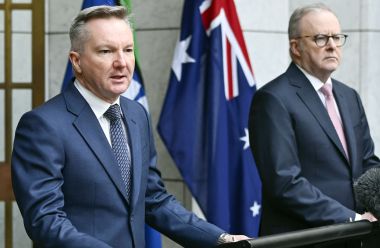
Sydney-Middle East Times Int'l:The press conference at Port Botany sets out the Australian Government’s intensifying response to mounting risks to fuel supply caused by instability in the Middle East. While the tone remains measured, the substance reflects a significant escalation in both government intervention and coordination with private industry. The central message is that Australia is acting decisively to secure fuel supplies, manage volatility, and protect consumers and key sectors of the economy from external shocks.
At the core of the announcement is the confirmation that the Government, through Export Finance Australia (EFA), has facilitated the delivery of an additional 200 million litres of diesel, building on a previously announced 100 million litres. These new shipments—sourced from South Korea, Malaysia, and Brunei—are being delivered in partnership with major fuel suppliers BP and Viva Energy. Each cargo is approximately 50 million litres, with deliveries expected by late May or early June and distributed across key locations including Brisbane, Geelong, Sydney, and Kwinana in Western Australia.
This additional fuel is explicitly framed as a buffer supply, supplementing Australia’s already substantial import pipeline. Industry representatives highlighted that around 60 cargoes are already scheduled to arrive in the coming months as part of normal operations, with 61 ships currently en route. However, the Government’s intervention enables companies to secure extra cargoes beyond standard commercial arrangements, effectively increasing national reserves at a critical time.
BP Australia President Paul Augé emphasised the importance of global supply chains, noting that fuel shipments are arriving from diverse sources, including the United States. He credited the Government’s partnership with enabling faster and more flexible procurement, particularly in a market characterised by uncertainty and competition for available supply. The collaboration with EFA, he noted, ensures that Australia can access additional cargoes when needed, reinforcing resilience in the system.
The broader policy framework underpinning these actions is the Government’s National Fuel Security Plan, which has moved into what the Prime Minister described as a “Level 2” response. This stage includes voluntary conservation measures alongside active supply-side interventions. The emphasis is on preparedness without imposing mandatory restrictions, encouraging both industry and consumers to remain mindful of fuel usage while supply conditions remain uncertain.
A recurring theme throughout the press conference is the global nature of the crisis. The conflict in the Middle East is described as highly volatile, with rapidly changing conditions that are beyond Australia’s direct control. Particular concern was raised about disruptions to shipping routes, especially through the Strait of Hormuz, as well as potential damage to energy infrastructure in the Gulf region. These factors contribute not only to price pressures but also to logistical delays, with fuel shipments often taking weeks to complete round trips.
The Prime Minister underscored the concept of a “long tail” in supply disruptions, explaining that even if conditions stabilise, delays and bottlenecks in the supply chain could continue to affect availability for an extended period. This reinforces the rationale for building additional stockpiles now, rather than reacting later when shortages may become more acute.
In addition to supply measures, the Government highlighted its decision to cut fuel excise by 32 cents per litre, a policy aimed at directly reducing costs for consumers. This temporary measure, currently in place until June 30, is positioned as part of a broader effort to shield households and businesses from rising energy costs. While no commitment was made بشأن extending the cut, the Prime Minister acknowledged the high level of uncertainty and left open the possibility of future adjustments depending on global conditions.
The Government also pointed to close coordination across jurisdictions and sectors as a key strength of its response. National Cabinet is meeting regularly, and energy ministers from states and territories are in ongoing discussions to ensure alignment. At the same time, federal authorities are working closely with private companies—including BP, Viva Energy, Ampol, and others—to monitor supply and identify further opportunities to secure additional fuel.
Beyond fuel, the press conference briefly touched on related economic measures, including efforts to secure fertiliser supplies for Australian farmers. An agreement with Indonesia to provide an additional 250,000 tonnes of fertiliser was highlighted as an example of proactive international engagement aimed at protecting domestic industries from global disruptions.
Politically, the Prime Minister used the opportunity to push back against criticism that the scale of additional fuel—sometimes described as equivalent to only a day’s supply—was insufficient or symbolic. He argued that such critiques ignore the counterfactual, namely what would happen if the Government failed to act. The emphasis was on cumulative impact: multiple shipments, secured in rapid succession, contribute to a meaningful increase in national reserves and provide greater confidence in supply continuity.
The Government’s communication strategy also reflects an effort to balance reassurance with realism. While acknowledging that current supply levels are stable and prices have eased somewhat, officials cautioned against complacency. The message is that conditions can change quickly, and preparedness is essential to mitigate potential shocks.
In summary, the press conference presents a picture of a Government adopting a highly interventionist and coordinated approach to fuel security in response to global instability. By leveraging financial mechanisms, strengthening industry partnerships, and maintaining flexibility in policy settings, Australia aims to stay ahead of potential disruptions. The strategy is not only about managing immediate risks but also about reinforcing the resilience of supply chains in an increasingly unpredictable international environment.
|
|
|
|
|
|