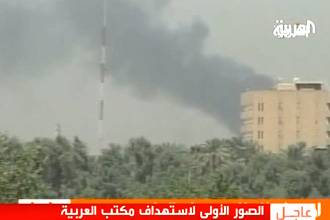
Baghdad suicide bomber targets Al Arabiya office 4 killed, 10 injured in Al Arabiya suicide bombing  BAGHDAD- At least four people were killed and more than 10 others wounded in Baghdad on Monday when a suicide bomber blew up a vehicle by the offices of Al Arabiya, its correspondent in Baghdad and interior ministry officials said. The bomber struck at around 9:00 am (0600 GMT) in front of the station's bureau in the city center, according to an interior ministry official, and sending a plume of smoke into the air that could be seen from several kilometers (a few miles) away. Majid Hamid, Al Arabiya's Baghdad-based correspondent, said the bomber was able to pass through the first security gate and detonated the bomb in front the channel's office. The bomber, who was driving a minibus, was apparently waved through the first checkpoint after security guards checked his identification, Iraqi military spokesman Maj. Gen. Qassim al-Moussawi said. He said three guards and a cleaning woman were killed in the blast that left another 10 injured. Al-Moussawi said Iraqi officials had previously found al-Qaida documents indicating the militant group planned to target Arab news channels in the country. "This has the clear fingerprints of al-Qaeda," al-Moussawi told Al Arabiya. Al-Arabiya correspondent Tarek Maher said he was in the building when the blast occurred. He said the building sustained heavy damage and the explosion left a massive crater. The pan-Arab television channel is among the most popular Arabic news stations and has been targeted in the past. In September 2008, its Baghdad bureau chief, Jawad Hattab, escaped unharmed after spotting a bomb, which would-be assassins had attached to his car, before it was detonated by remote control. In October 2006, a car bomb targeting the channel's then bureau killed seven people and wounded 20. And in February 2006, Al Arabiya presenter Atwar Bahjat and two of her colleagues were kidnapped and murdered in the town of Samarra north of Baghdad as they covered the bombing of a revered Shiite shrine, an attack claimed by al-Qaeda that plunged the country into sectarian bloodshed. Iraq is on high alert for insurgent attacks after a March 7 national election produced no clear winner and left the country adrift in political uncertainty. Overall violence has dropped sharply since the height of sectarian carnage in 2006-7. But daily bombings and killings continue, suggesting insurgents are trying to exploit the vacuum as political rivals jostle for power. Iran gives Taliban money, arms and training (AFP) 26 July 2010, WASHINGTON — Iran is waging a covert campaign against US-led forces in neighboring Afghanistan by providing money, arms, training and safe haven to Taliban insurgents, according to leaked US military intelligence. Reports from Afghan spies and paid informants, described in papers published on whistleblower website Wikileaks, accuse the Iranian government of directly supporting the insurgents. These “threat reports†cannot be corroborated, the Guardian newspaper said in a report summarizing the Iran findings, but high-level US diplomatic communications indicate concern over Iran’s growing involvement in the country. “Iran has taken a series of steps to expand and deepen its influence in Afghanistan,†reads a summary of a secret cable sourced to the US embassy in Kabul and written by a deputy general. The cable relayed claims from within the Afghan foreign ministry that Iran was bribing Afghan MPs with millions of US dollars and working to oust reformist ministers. Tehran, which initially supported the US drive to unseat Afghanistan’s Taliban regime, denies it is working against President Hamid Karzai’s Western-backed government. In a document dated March 2009, US military intelligence said a group of more than 100 Afghan and foreign Taliban had travelled from Iran to Afghanistan to launch suicide attacks. In May the same year, General Stanley McChrystal, then US and NATO commander, said according to the documents: “The training (of insurgents) that we have seen occurs inside Iran with fighters moving inside Iran.†A threat report dated February 2005 alleged Taliban leaders in Iran were planning attacks in Helmand and Uruzgan provinces. “The leaders travel into Afghanistan to recruit soldiers,†said the report. It added the Iranian government had offered each leader about 1,740 dollars for any Afghan soldier killed and 3,480 dollars for any government official. Another report from January 2005 said that Iranian intelligence services paid 10 million Afghanis (212,000 dollars) to the Hezb-e-Islami Gulbuddin rebel militia. A statement sourced to “human intelligence†in June 2006 said Iranian officials were training members of the Taliban and Hezb-e-Islami Gulbuddin in Birjand, Iran. Bombs and vehicles for suicide bombers were sent into Afghanistan from there, the same report said, while two other reports also spoke of bomb-making equipment coming from Iran. One report dated February 2007 said Helmand residents believed Iran had supplied the Taliban with a poison to be slipped into the tea or food of government officials. At least one document referred to the Afghan government’s reluctance to publicize Iran’s alleged involvement with its enemies, stressing that Karzai wanted “to avoid additional friction with Afghanistan’s neighbors.†Libya suspends diplomatic operations in South Korea July 26, 2010 Seoul: Libya has suspended diplomatic operations in South Korea, amid reports of deteriorating relations between the two countries. The Foreign Ministry, on Monday, confirmed Libya has closed its de facto embassy, an economic cooperation office, in Seoul which means Koreans must now travel to other countries to obtain visas. It gave no reason for the move. "There has been no formal notice that Libya will close its economic cooperation bureau here, but we understand that operations there are temporarily suspended," spokesman Kim Young-Sun told a briefing. Seoul and Tripoli have built strong economic ties since establishing diplomatic relations in 1980, with South Korean firms winning a series of massive civil engineering contracts there. But the relationship began to turn sour last March when Libya complained that the South Korean media and school textbooks both carried negative descriptions of leader Moamer Kadhafi and the country in general, the JoongAng Ilbo newspaper reported. Also a South Korean Christian pastor has been detained in the Islamic nation for a month since his arrest for alleged missionary activities and this has further affected the relationship.†Consular access to the detained South Korean has been denied since his arrest on charges of violating Libya's religious law," a Seoul Foreign Ministry official said. "He was arrested about a month ago and is still being detained for questioning. The government is trying to give him as much support as possible. It is rare to have one of our citizens detained in Libya." Another South Korean, a resident of Libya, is being questioned for allegedly helping the pastor. 'Niqab fatwa' supported by Kuwaiti religious scholars        Monday,26 July 2010 KUWAIT: A number of Kuwaiti religious scholars have announced their support of the recent fatwa by the Saudi religious scholar Dr. Ayedh Al-Garni regarding the possibility of wearing the niqab (a garment that covers the entire face). The Saudi scholar indicated that women who live in countries that ban the niqab can wear the head veil instead. On his part, the Kuwaiti religious scholar Nazem Al-Mesbah noted that this issue is controversial, with some within the clergy supporting the niqab while others say that women have the choice to either wear one or not. Most religious scholars agree that that niqab is aimed to protect women, however if the women faces a threat in a foreign state for donning the garment, then she should remove it. The Kuwaiti scholars highlighted that some women may need to travel to countries that ban the niqab for medical or other purposes, therefore they can wear the head veil in order to protect herself against any harm. The Shia'a religious scholar Sayyid Mohammad Baqer Al-Mohri supported the fatwa by the Saudi clerk, saying that most Shia'a clergymen believe that women have the option for wearing the niqab or the veil that covers only the hair. Al-Nassma to be Godiva of Middle East: expert Dubai exports camel milk chocolate DUBAI -Less than a year after its establishment, the Dubai-based first camel milk chocolate company is now ready to invade global markets with a new flavor to the world's most popular sweet. In October 2009, Dubai ruler Sheikh Mohammed bin Rashid Al Maktoum established al-Nassma which, in partnership Austrian chocolate manufacturer Manner, aims at producing 100 tons of what it calls "the Godiva of the Middle East." " Camel milk is healthier than cow milk. It contains five times more vitamin C, less fat, less lactose and more insulin. This makes it perfect for people with diabetes and lactose intolerance " Al-Nassma General Manager Martin Van Almsick The world's first camel chocolate will be exported to Arab countries as well as Europe, the United States, and Japan. The company is specifically planning to sell its chocolate at London's Harrods. Al-Nassma is currently selling its products in the store attached to its farm, which houses 3,000 camels, as well as in luxury hotels and private airlines. Online shopping of al-Nassma chocolates will be launched within a month. The Gulf is the best place to launch camel milk chocolate since it is home to the best camel breeds and camel milk is part of its diet due to its numerous benefits, said Martin Van Almsick, al-Nessma general manager and former manager of the chocolate museum in Cologne, Germany. "Camel milk is healthier than cow milk," he told Al Arabiya. "It contains five times more vitamin C, less fat, less lactose and more insulin. This makes it perfect for people with diabetes and lactose intolerance." Since al-Nassma chocolate is a luxury product, Van Almsick added, it will not be sold in supermarkets, but one mall in each UAE city will have an outlet. "We aim to be the Godiva of the Middle East." Van Almsick, who is a world renowned confectionary and chocolate expert, pointed out that the new camel milk chocolate does not contain preservatives or chemical additives. It is basically made of local spices, nuts, and honey. This makes its expiry date a bit different from other products. "The expiry date depends on the ingredients. For example, the plain bar lasts for nine months while the stuffed one expires after six months." UAE chocolate market Al-Nassma manufactures world's first camel milk chocolate bars Nutrition experts argue the sale of cocoa in emerging markets helps in boosting confectionary markets at the time of economic slowdown. While sales in chocolate producing and traditional chocolate loving countries dropped, they added, a remarkable rise in chocolate consumption is seen in the Middle East and Asia. According to ACNielsen Retail Audit, the UAE chocolate market is estimated at 546 million dirhams ($148 million) with a growth rate of 27% by value and 14% by volume. A recent study conducted in the UAE also revealed that 98% of surveyed people eat chocolate at least once a week. |